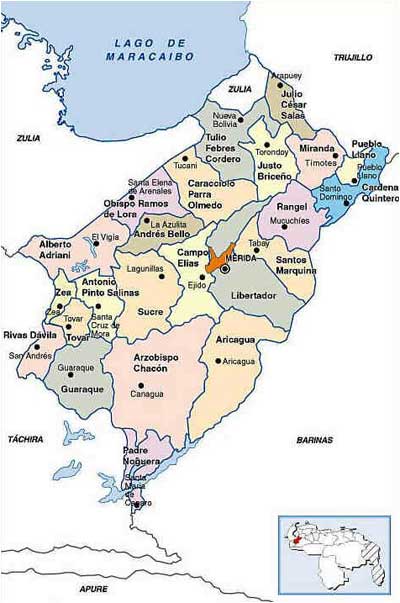
Mérida - State


Capital of the State: Mérida, founded in 1558
State Population: approx. 700,000 persons (im the year 2001)
City of Mérida: approx. 240,000 persons
City altitude: 1,650 m.a.s.l. / 5,100 feet
Surface: 11,300 sqkm (1,130 hectare).
Size: 3.2 km (2 miles) wide by 6 km (4 miles) long.
Location: 680 km (422 miles) Southwest of Caracas or, 1 hour via plane or 12 hours via car.
Climate: Average temperatures 25ºC (77ºF) during the day and 13ºC (55.4ºF) in the night
Average Temperature: 19ºC / 66.2ºF
Nearest Airports: Center of Mèrida (MRD), plus El VigÌa (VIG) 1.5 hours and Barinas (BNS) 3.5 hours
Telf. Area code: 0274 (country code is ++58)

Mérida is the highest state in The Andes, and is the only place in the country where you can see mountains covered with year round snow (especially between July and September). The State of Mérida offers the tourist many different choices.

What are your interests?
Walk back in time, and history, visiting old houses where you can still see the traditions and culture in the people's hands, faces and eyes!. If you are perceptive, each route you choose, will reveal a difference in climate, vegetation, soil conditions, and topographic (before roads, electricity, or telephone service) restraints; thus creating a natural force or barrier out of which each village grew to be distinct from the other. History not only provides a link with the past, but often, will provide a clue into the future.
This being so rare in a Caribbean country, except for a small area near Maracaibo Lake, and an altitude of less than 500 meters (1,640 ft), it is a highly mountain state.
Its snowy peaks, a good temperature, and its cold river waters give Mérida unique characteristics among the other Venezuelan states that share tropical forest to Andean highlands (páramos), with more than 400 species of plants. The fauna of this region is characterized by such birds as the mountain widows, gúiri ducks, partridges, hummingbirds, parrots, mammals, wild rabbits, porcupines, condors, bears, and one endangered hundreds of lakes, most of them of glaciar origin and crisscrossed by an intricate network of rushing rivers and streams. In some regions the altitude is it for coffee farming; Mérida being an important producer of it. Its climatic diversity also allows for other farming activities, such as potatoes, wheat, sugar cane, tobacco, plantains, fruits and flowers.
Pico BolÌvar is the highest mountain in the country, and perhaps Mèrida's most superb and attractive mountain peak.
It is surrounded by other peaks equally as high, and the government has declared this zone a National Park under the name of
Parque Nacional Sierra Nevada, Rincón, etc., snowing is frequent and the rain level is high. Mérida is an alpinist paradise, and its rivers and lakes offer excellent possibilities for trout fishing. For those who are not interested in sport or risk hiking to see snow-capped mountains, the Teleférico (World's Highest and Longest Cable Car) is ready to take them to Pico Espejo (4,753m / 15,594 ft). You will enjoy the landscape during the 12,500 m (7,767 mi) ascent. On the summit you will be able to observe Pico BolÌvar and other neighboring mountains. Mérida is also the state's capital. It is a neat city with plenty of tourist sites, many well-kept plazas, parks, excellent hotels, museums, and an intense artistic and cultural activity. It also has a model tourist information service. The quiet villages scattered along the trans-Andean highway are worth visiting: MucuchÌes, Timotes, Santo Domingo and Chachopo. At the Pico El ¡guila (4,118 m / 13,510 ft) here the highest cross roads in Venezuela is a monument erected in the memory of the Libertador Simón BolÌvar.